Thursday, 27 August 2020

SYOS Signature Tenor Mouthpiece demo: Jazz Sound

The SYOS artists' lockdown collaboration video of Alone Together, in the Spring of 2020, left an awful lot of music on the cutting room floor, including this entire take. The video is designed to demonstrate the warmer, jazzier side of my signature tenor mouthpiece to demonstrate that it's not just a screamer!


The video was fun to do and comes with the transcription running alongside the music.
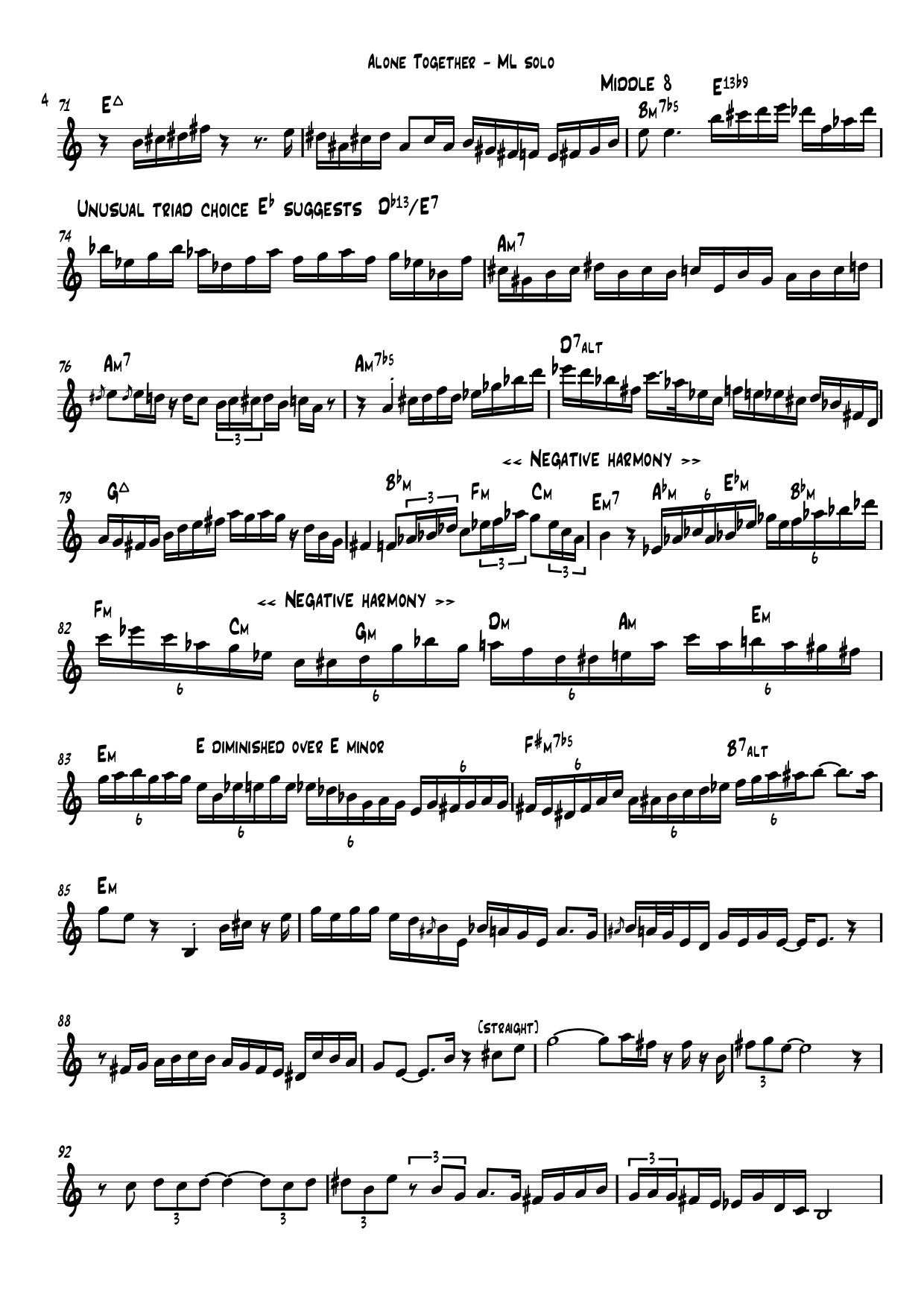
Here is the full, written transcription with annotations and analysis:

Summary of techniques here:

1) Bar 6. This is a classic. When modulating to the sub dominant in the minor, transpose your phrase up a semitone to make it the altered dominant.

2) Bar 9. C#m7 to F#7, Am7 to D7 to G is the sequence of the song so it is a small step to complete the Giant Steps cycle with an Eb major cadence.

3) Bar 13. Negative Harmony. The backwards circle of 5ths using minors, heading for the C minor, the B7 altered dominant.

4) Bar 14. Conventional whole tone scale, augmented triads, but a set-up for the more complex triad relationships coming up later.

5) Bar 23. Free variation of the Giant Steps substitutions used previously.

6) Bar 27. Lydian major 7th with the tone above pentatonic.

7) Bar 29. Diminished scale for E7b9 with Db triad for the 13b9 effect.

8) Bar 30. Chromatic approaches make the classic diminished scale less 'patterny'

9) Different rhythmic variations - here seven groups of 4 fill up the bar.

10) Bar 33. For the C false fingering the bottom C fingering loses the B finger, which helps tuning.

11) Bar 34. The tritone substitution is easily swapped for the altered dominant.

12) Bar 38. One of Slonimsky's 12-tone triad combinations (page 177 of the Thesaurus book)

13) Bar 45. Four key 'Septatonic System'. Melodic minor with flattened 4th: E,F#,G,Bb,B,C#,D# divided {Eb,G,Bb}+{E,F#,B,C#}. The second group fits the tonic scale, the Eb triad is outside. Also transposed to A, D and G to fit nicely with E minor Dorian.

14) Bar 56. A Giant Steps take on the Sonny Stitt technique of playing a dominant up a semitone and back. F#m7-G7 >Ab7-Db-E7 > Eb7,Ab,B7 > E

15) Bar 73. The Db triad of the E13b9 has a pull of its own. Playing with the Db tonality by giving the impression of a Lydian dominant gives the startling effect of an Eb triad over an E7. The Ab minor melodic resolving up a semitone to A minor is a nice variation of the Negative Harmony effect.



Further Explanation of some of the techniques

1) Semitone up for the Altered.


This is a nice technique for modulating to the IV chord in a minor blues. Here E minor melodic for the tonic and F minor melodic for the E7 altered. Some players stretch out the E altered by going early and/or resolving late, to maximise the out of key effect. John Coltrane was an early exponent of this and later Steve Grossman, Chick Corea, Bob Berg and Michael Brecker.


2) Giant Steps substitutions.


John Coltrane famously pioneered the triple tonic system as an alternative to the cycle of fifths, perhaps hitting on the idea after hearing the Richard Rogers song 'Have You Met Miss Jones' from 1937. In this solo C#m7-F#7 > Am7-D7> G is substituted with B (or C#m7) > D7-G-Bb7-Eb-F#7-B-D7 > G.

Later in the solo this formula is treated more and more freely, in a manner similar to the style of John Coltrane from 'A Love Supreme' onwards, culminating arguably in his amazing album 'Interstellar Space'. For more on this refer back to the blog entry from February 2nd for a Coltrane example of this technique.

Here are the other three variations on the video:

From bar 23:


From bar 53:


and bar 67:


3) Negative Harmony Coming Soon!

Sunday, 2 February 2020

Kromololodics #3 Coltrane got there first!

Following on from March 2018 and our examination of Sebastiaan DeKrom's concept of multi-layered chord sequences, a recent look at Resolution from A Love Supreme proves that John Coltrane was way ahead of us already in 1964:

On one level Resolution from A Love Supreme is the first eight of Bernie's Tune, dissolving into a one-chord minor improvisation. In the event this piece is incredibly ground-breaking and experimental. In the course of his solo, laying the spiritual aspect of the album aside for a moment, Coltrane returns to his preoccupation with a cadence into the key of Eb, which goes back to Blue Train and runs through Moments Notice, Lazy Bird and Giant Steps. In this it really does seem as if Coltrane likes to work out his concepts by improvising live on an important record date. There is nothing remotely 'licky' about his solo on Resolution. Each of his recorded performances of this piece sound completely different and fresh to our ears even now half a century later.

This extract from Resolution (5mins, 5 secs on the track) demonstrates that Coltrane is using the C7 altered scale (C# melodic minor) to resolve the eight-bar sections, but subtly changing his lines so that they can co-exist in a minor V-I in F (sax key) as well as a simultaneous progression following the sequence of Giant Steps, in its original key. The augmented nature of the 'altered' chord facilitate this. There is also a hint of the 'backdoor' resolution Bbm-Eb7 to F, together with its Giant Steps progressions. Coltrane is freestyling his lines, but also operating intellectually on two or three levels at once. Part of the magic and mystique of John Coltrane is that we still cannot exactly pinpoint his thought processes towards his musical goals. Coltrane's playing has inspired some people towards a totally free approach and others to seek a greater degree of structure in melodic construction. It is fascinating that different people transcribing a solo, like this extract from Resolution, could draw completely different conclusions from the notes. A chance decision to use sharps or flat, or the theoretical knowledge that the transcriber possesses could lead to a different result.


Friday, 20 December 2019

SYOS Soprano Mouthpiece Demo - Negative Harmony Rhythm Changes

In this video (in which incidentally I am demonstrating my new signature soprano mouthpiece produced by SYOS in Paris) the concept of Negative Harmony chord substitutions is much more developed than in previous examples. The concept derives, readers will remember or can scroll down, from Sonny Rollins's and Sonny Stitt's circle of 5th substitution system, as used in 'The Eternal Triangle'. Appropriately enough this time, the Negative cycle of minors in 4ths, in numerous guises, is expressed this time within the tight form of Rhythm Changes:


Analysis: Initially I aim for the subdominant chord in bar 6 of the sequence: Gm, Dm, Am, Em, Bm, F#m, C#m, G#m, Ebm, Bbm -> F7, Fm7, then rounding off the first 8 with a two-bar, 'backdoor' negative loop turnaround - C, F#m, C#m, G#m -> C. In Negative Harmony the diminished chord is invertible, as are tritone substitutuions, so Fm > C as V-I and the 'Backdoor' G#m > C can be transposed to give Bm > C and Dm > C. All four are valid resolutions for a chain of chords. In addition to this it is possible to jump between these streams. In conventional musical theory D7, Db7 > C can be used as a substitution for the cycle of fifths. In this negative theory the equivalent would be Em, Fm > C., ascending in semitones. Jumping to the Backdoor stream would give Bbm, G#m > C, descending in tones. A major third jump up such as C#m, Fm > C is the fourth move possible within this system. These four moves can be mixed freely, giving many possible ways to construct alternatives sequences.

In the first bridge I am approaching the main chords i.e. A7 in the 3rd bar, using the 'Backdoor' route. The last two bars of this middle eight are a tritone substitution backdoor: G#m, Cm, Gm, Dm, giving a conventional Dm where the G7 would normally be!

At Bar 33, last 8, first chorus, I use the backdoor tritone progression with a mixture of 5 and 6 note groupings starting on the One: Em(for C major7), Bm, F#m, C#m, G#m, Ebm, Bbm, Fm, Cm, Gm(for C7) > F7, propelling things into what will be the last chorus.

In Bar 49 (second chorus, second eight) I run a long sequence with five-beat groupings, starting with Ab minor, aiming ultimately for C, although there is not enough time (it's improvising!) and the C becomes Fm of an E7 altered chord for the start of the bridge.

Altogether this system works because the listener hears the pull towards the cadence points, although vertically the idea of a chord played on top of, or in place of, another chord is virtually a lost concept here. One of the central concepts behind this is the idea of movement within music, to keep the interest and energy moving forward.

Once again I am indebted to the people at SYOS, or Shape Your Own Sound, for their help in developing the mouthpiece, which is an incredibly versatile, free-blowing piece of kit.

The soprano sax is a P. Mauriat PMSS-601DK, 'saxello' style instrument, kindly provided for me by the company back in 2007 and still going strong.


Friday, 26 April 2019

I Can't Get Started Transcription

To showcase my new signature model SYOS alto mouthpiece and Signature Custom alto sax, I posted a short improvisation around the classic standard 'I Can't Get Started'. This is a reference to the forward-thinking Paul Bley piano solo entitled 'Started' and as such some of my old and new systems are combined here.


The introduction uses Olivier Messiaen's third mode, a nine note scale which comprises of 1,2,3 of the minor scale, played three times, a major third higher each time. This affords many rich possibilities of combining major and minor 7th and half-diminished arpeggios within that triple tonic axis. John Coltrane uses some similar constructions in his 'I Want To Talk About You' cadenza and later on in 'Interstellar Space'. The scale here is A,B,C,C#,D#,E,F,G,Ab.

When the theme arrives, the 'I Can't Get Started' tonic chord A major seven is formed from the centre of a sharpened 23rd Chord with an implied G root, although the G is never heard. The rest of the chord is stated in the solo: (G), B, D, F, A, C#, E, G#, B#, D#, F#, A#. The idea behind the 23rd chord is to stack thirds until all twelve notes have been used. The A major here actually is drawn from the middle of the chord, allowing a different light to be shone on it from above and below.

At the point in the standard sequence (bar 3) where the beboppers put their string of descending II-Vs, I did start on the G# minor (alto key), but played right through the Negative Harmony plagal cycle of minors, resolving on F minor as if it was an altered dominant, back to A major.

The SYOS mouthpiece (my own Signature) and the Signature Custom horn work really well together. The sound has a lot of flexibility and homogeneity across the range, as you can hear. It is incredibly easy to float out the top A# in the 23rd chord, and even the fourth register C#, E and G# at the end of the solo. I am very grateful to both companies, one in Paris and one in Kent, England for giving me the opportunity to create this splendid 'entente cordiale'.


Tuesday, 31 July 2018

Negative Harmony Update: Cherokee with Negative Polarity Chains

  John Coltrane developed the concept of bebop chord substitutions to include his own triple tonic Giant Steps system. These superimposed, alternative sequences could be used to replace the regular changes of a tune, although the cadential, polarity points would remain the same. Coltrane's version of Charlie Parker's 'Confirmation', entitled '26-6', is one of the best known examples.


  In this video I am playing the sequence of 'Cherokee' using chains of Negative Harmony 7th chords, polarised towards the important cycle of fifths junctures in the regular sequence. The 'backdoor' IVm-bVII can also be expressed with Negative Harmony ideas, as can the tritone versions of both progressions. Following these chains and loops, strings of minor plagal moves, gives a me wonderful sense of falling backwards through space. There is a feeling of navigating a parachute drop gently on to the cadence point, rather than the sharp, tension-release of regular jazz harmony. Using tritone substitutions of the Negative Harmony minor 6th chord movement gives a rising semitone sequence (D7-G7-C7 = Bbm-Fm-Cm or D7-Db7-C7 = Bbm-Bm-Cm) another marvellous, liberating feeling for a jazz musician who has been tied into the cycle of fifths for thirty years. A 'backdoor' version can also be mixed in: (Dm-G7-C = Dm-Ebm-Bbm-Fm-C) therefore (Fm7-Bb7-C = Fm-F#m-C#m-G#m-C).

  Here is a transcription of what I play in the video. The pulse comes and goes, giving it a sort of fantasia feel. I was short of breath, as the temperature in Ruislip that day in July 2018 was about 33ºC and Lockett Towers was not blessed with air-conditioning!


Friday, 9 March 2018

Kromolodics #2 It Don't Mean A Thing vs. Cherokee


 This is a more advanced Kromolodic puzzle: Ray Noble's 'Cherokee' is 64 bars long, moving a semitone higher in the third 16 before working its way back to the tonic key. Duke Ellington's 'It Don't Mean A Thing If It Ain't Got That Swing' is a typical 32 bar sequence resolving in the same key, but beginning on the relative minor. In a Kromolodic improvisation the player would have to reconcile the double length form of Cherokee against the Ellington sequence. Taking things a stage further, it is interesting to try the first 16 of Cherokee and the bridge simultaneously, together with the sequence of It Don't Mean A Thing. In a perfect Kromolodic solution each cadence of (all three sequences!) would be referenced, the musical essence and polarities of each tune would be retained, and the line would work if either tune were played straight by an unsuspecting band:


Kromolodic Line: It Don't Mean A Thing versus Cherokee

Studying Ernst Levi's Negative Harmony, Ornette Coleman's Harmolodics, Lennie Tristano's techniques of rhythmic displacement and side-slipping, and also John Coltrane's Giant Steps substitute progressions will all help to visualise how Kromolodics works. The fact that Sebastiaan De Krom, a drummer, invented this technique is absolutely key here. The drummer feels the rhythmic and harmonic polarities heading towards the important junctures of the tunes, and all the musical forces converging at these points. As a means of generating interesting melodic lines Kromolodics is exciting and compelling, and has all sorts of implications across the board.

  The late, great free jazz trombonist Albert Manglesdorff showed me at a class some years ago how he sometimes visualised imaginary chord progressions, as an alternative to playing 'free'. Hermann Hesse's novel The Glass Bead Game, beloved of composer Karl Heinz Stockhausen, is a fascinating book about examining seemingly unconnected elements and finding commonalities. Kromolodics is a very new art with all sorts of interesting applications. It remains to be seen how far improvising musicians will be able to take it.


Friday, 2 March 2018

Kromolodics - A Revolutionary Concept in Jazz


The celebrated London-based, Dutch/U.S. drummer Sebastiaan De Krom has hit upon a completely new intellectual concept in melodic jazz, which is making musicians' heads spin all over town. His weekly trio gig at the Troubadour in Kensington, at which Sebastiaan has been reworking the Sonny Rollins trio concept, has become a laboratory for radical ideas and ground-breaking techniques. De Krom's trio arrangement of Green Dolphin Street requires that the saxophone and bass player, for extended periods, visualise the chord sequence of the song, and the sequence of Night and Day at the same time! This also takes into account the fact that the lengths of the forms of the tunes are different. At first glance this looks like madness, but when you take the plunge it is incredibly liberating. With a lot of listening the experience is similar to how Charlie Haden must have felt, following Ornette Coleman's harmolodics by ear into unknown territories in the early 1960s.

  In the 'Kromolodics' arrangement of Green Dolphin vs. Night and Day, there is plenty to work with, There are tonic polarity points every four or eight bars, and contemporary melodic improvisers should have no problem with blurring the lines between major and minor tonality, or using Phrygian modes in place of dominants. The second half of the bridge of Green Dolphin Street, superimposed a minor third above the tonic II-V-I has a diminished 'four tonics' sound, or even the Negative Harmony, minor plagal feel to it. However, the idea for the improvising musician of holding two ideas in the mind at once for such an extended period of time is perhaps the most revolutionary idea De Krom has come up with. At a recent session, by dipping into Jerry Bergonzi's famous Night and Day vs. Giant Steps sequence, I was able to keep three plates spinning at once. The bass player present was the superb, open-minded and -eared Oli Hayhurst, with De Krom himself grinning broadly from the drums as the mayhem unfolded.


Negative Harmony Stella by Starlight


Pudding points the way forward


This reworking of Stella is an exercise in blending Negative and regular harmonic principles. The cadences are negative but I have stuck to the modulating keys in the positive - Bb major to Eb major etc.. This is therefore not a true inversion, but it did make it easier to stick closely to the original Victor Young melody and preserve the essence of the song. In this way it was possible to arrive at a reharmonisation in which the constant twists in Stella by Starlight between major and minor keys were reversed. Funnily enough the drama of the song is preserved, transformed, and quite a pleasing effect is achieved. I have taken numerous liberties in order to form musically satisfying chords, and I am not bothered whether this is proper Negative Harmony or not. I have also used 9th chords, as would be usual in a modern jazz performance. For the first chord for example, the intervals of the half diminished chord reversed would create a dominant 7th. Continuing down to the 9th would give a rather poor sounding minor 7th chord with a flat 9th. In regular harmony a diatonic 9th on a half diminished chord would also give a nasty chord with a flat 9th, so pianists from Bill Evans onwards changed this 9th to a natural 9th, for a very expressive chord. In the same way, if we widen the interval with the Negative Harmony chord, we get a major 7th with a #5 and natural 9th, a much better chord.

Here is an analysis of the first twelve bars, in which major and minor II-Vs and the so-called 'backdoor' cadence, the Negative Harmony, minor plagal in the positive world, are all used. To see how the Negative keys are achieved, refer to my previous posting on Negative Harmony:


Here is the full Stella by Starlight reworking. I hope it is musically satisfying to some extent and fun to play. It certainly takes you out of the box, as the usual formulas and licks for cycle of fifths harmony will not work:


Monday, 21 August 2017

That Negative Harmony Talk Unravelled


Photo: Tatiana Gorilovsky (Peter King's 75th Birthday, 606 Club, 2015)


   I was delighted that my lecture on Negative Harmony in France a couple of weeks ago drew a great deal of interest, many probing questions and a not a little controversy. The subject came up because a number of my students, enthused by Jacob Collier, had asked me about Negative Harmony, so I thought I ought to get up to speed with the kids! In order to find a way to work with this system, I set two musical criteria: (i) The chords could always be tweaked, extended or inverted, just as regular jazz chords would be in a reharmonisation. (ii) The goal would be to always to create musically satisfying sounds rather than awkward chords in order to be true to the 'rules'.

   Negative Harmony is offers a darker, more thoughtful, minor or Subdominant alternative to the extravert, bright Tonic-Dominant relationships of classical music. The main problem with Negative Harmony is that it is supposed to be derived by an reversing polarities inherent in the natural harmonic overtone series, while at the same time applying mathematical ideas using equal temperament, which is an artificial creation. The idea of an upside-down 'undertone' series below the tonic, which cannot be heard, is pure hokum. This does not mean that it is not possible to use some of the ideas from Negative Harmony to find new sounds and make interesting music.

   The idea of a pull between the the root and the fifth, the first natural harmonic that produces a different note, is fundamental to a lot of music theory. The first melody ever blown on an animal horn (in Greenland allegedly) would have been a fifth, and we are hard-wired to recognise the primacy of this interval. Negative Harmony creator Ernst Levi used 19th century analyst Hugo Riemann's reversed major triad (C major: C-E-G becomes C minor: G-Eb-C, built from the G downwards using the same intervals) and built a scale of triads coming downwards from the Dominant G, starting with G-Eb-C and using the same intervals as the regular major scale. This produces 'Negative C major', a Phrygian scale of G, with chord I being Cm and chord V being Fm or Fm6 if the chord is extended down to include the 7th. Moving from Fm6 to Cm creates a minor Plagal cadence in place of the regular Perfect one, and this is one of the characteristic sounds of Negative harmony. Some theorists argue about whether the F in the Fm6 should be the bass note, or whether the chord is Dm7b5. The problem here is that we are used to hearing the lowest note as the bass note, not the top note as the generating root. Anyone familiar with Bill Evans however will be aware of the concept of rootless voicings - the chord could be Fm6, Dm7b5 or even Bb9 to him. As jazz musicians therefore, we need not be overly concerned about this, nor bound to the rules at the expense of good sounds. II-V-I in Negative C could therefore be Gm7 to Dm7b5 to Ab major7, or even Eb major7 to Bb9 to Fm9 if all the chords are extended (down) to the 9ths.


   In applying this reverse, or 'reciprocal' principle to jazz standard harmony, all sorts of fascinating possibilities are occur. One of the most interesting questions concerns polarity. For example: is the first chord of an F blues a tonic chord, (F minor in Negative) or, as an F7, does it belong to its destination key in bar 5: Negative Bb major, making it a Cm7b5? The end of the blues sequence would have to have a II-V heading towards Negative F in any case. Another question is, should the Bb chord be a Cm, chord IV of Negative F, or should the harmony move in the opposite direction, to Negative C major? In a more complex jazz standard with many changes of key, these relationships and choices become more and more interesting.

This interpretation of an F blues (below) supposes that the first chord is a tonic chord, a 6th/9th in fact, as it was often played during the 30s and 40s. With all the intervals inverted, this gives a Bb7sus chord as the the first chord. In bar 4, when the chord becomes F7 for the modulation, the chord is Dm7b5, or Bb9 here, which is Chord V in Negative C major, since we are modulating in the reverse direction to a normal blues. From bar 8 we have a simple Negative Harmony VI-II-V-I progression to complete the structure.


This is not really that interesting as a chord progression, but it does serve to demonstrate the principles involved. The idea of slipping down from the Bb7 onto the F7 conveys the relaxing Plagal feeling of Negative Harmony. At the end of the sequence the root movement Db-Abmj7-Eb-Bb again shows the negative 4ths cycle.

In a future post I am going to present a Negative Harmony interpretation of one of the most complex and tonally interesting jazz standards, Victor Young's Stella by Starlight.


Wednesday, 26 July 2017

Signature Custom Sax Masterclass at Sax.co.uk


   Here is a video from my Signature Custom masterclass at Sax.co.uk London, August 2016. Laurence Cottle, Mark Fletcher and myself play Donna Lee, with the Signature Custom alto, followed by Giant Steps on the tenor with the Donna Lee contrafact melody, and the sax solo through all twelve keys. Below the video link is a transcription of my alto solo on Donna Lee. I have added a few theory notes here and there, although I am playing mostly Closed System stuff which 'any fule' should 'kno'. Many thanks to Trevor James saxes and Sax.co.uk for hosting the event, and the guys from Fletch's Brew for their great playing! Check out the Ronnie Scott's Late Show listings for our next appearance at the club!


Wednesday, 24 June 2015

El Pinguino - new solo ideas for 2015

606 Club with Geoff Gascoyne and Mark Fletcher April 2015

As a foretaste of the 2015 Dordogne Jazz Summer School, taking place at Monteton in late July and August, I thought I would post a preview of an upcoming album featuring myself and some of the other tutors on the course.

Andrea Vicari's February session was the first time I had recorded a serious jazz album for two years, after a period of self-analysis and restructuring. I was pretty ring-rusty here but some of the new style was beginning to come through. Andrea, Dorian Lockett and Nic France gave me a superb groove, so I could just surf on or bounce off the rhythmic energy.

In this solo I was keen to bust out of the straitjacket of the two-chord flamenco vamp. The Spanish Phrygian, changed into a Hungarian rather than Harmonic Minor, was the starting point, containing the A and the Bb chords in one. Soon the stream-of-consciousness kicked in and I freely mixed the Hungarian with 23rd Chord patterns, Messaien Mode 3 Triple-Tonics, p2c2e atonality and some conventional Giant Steps subs, Augmented Scale, false fingerings and so on. I am quite pleased with some of it!

The solo is on SoundCloud here:


Saturday, 25 October 2014

Warne Marsh - Marshmallow 1949

The 'Three Tenors' Band with Don Weller (left) and Art Themen (centre)


Marshmallow

Following on from my analysis of Lee Konitz's tune 'Ice Cream Konitz', here is a look at Warne Marsh's 'Marshmallow':

Tenor saxophonist Warne Marsh is the least known of the triumvirate he forms with Lennie Tristano and Lee Konitz. His compositions share many of the techniques of his compatriots, but show that he clearly has his own style. Marsh's astonishing take on Cherokee 'Marshmallow' was written in 1949 when he was 22 years old. The fact that he named it after himself suggests that it may have been a personal landmark and it is a very bold statement. As usual with Cherokee contrafacts, Marshmallow is played at breakneck speed (cf. Stan Getz - 'Parker 51' and George Coleman - 'Apache Dance'). The melody soars to altissimo Ab and even B at high speed, making this easily the most virtuosic saxophone head of the 1940s and one of the most technically difficult of all time. Lee Konitz and Warne Marsh, two 22-year-olds at the top of their game, fly through the melody, making it sound very easy. The chains of perfect 4ths and crochet triplets give the piece a modernistic, other-worldly sound. Some of it sounds rather passé to our ears (the theme from Star Trek springs to mind immediately), but it was written in 1949, when people were fascinated with the new atomic age, 'B' Science Fiction movies ('King of the Rocket Men'…) were popular, and Orwell's 1984 was published. For 1949 listeners this must have sounded like jazz from another planet. On a more serious level, if the rhythmic framework of Marshmallow were played on a drum kit, with all its displacements and groupings, it could be a drum solo worthy of a Frank Zappa piece. Some of the techniques in the piece draw parallels with 20th century classical music and anticipate the post-modern jazz of the 70s and 80s.

Contrasting with the Lee Konitz piece previously analysed in this blog (Ice Cream Konitz), Warne Marsh does not make the same use of space, preferring more of a sense of urgency with long, winding lines in the bridge section. He uses a greater variety of superimposed triads and isorhythmic groupings and some very daring and original 'out-of-key' melodic effects and rhythmic displacements. Ice Cream Konitz is an early Konitz piece and a simple example however. Marsh's composition does not have an intimate relationship with the melody of Cherokee, as Konitz's piece does with Perdido, but Marsh achieves unity throughout the recording by extensive use of his compositional material in his improvised solo. In this he is moving towards pure improvisation rather than stylistic jazz playing.

16 techniques used by Warne Marsh in Marshmallow:

1) Harmony interpreted through superimposed triads: (expressed in C) D/C E/C A/C B/C F#/C (Bb/Cm)

2) Expression of the chords melodically using chains of 4ths (Wagner 'Tristan', Schoenberg Chamber Symphony, Charles Ives etc.)

3) Odd groupings over 4/4 time - 3,5,6 and 7 beat rhythmic and melodic patterns (1970s Chick Corea, Michael Brecker etc.)

4) 'Bending the barlines' - delayed or early resolutions and beginnings of phrases (Tristano, Konitz, Keith Jarrett)

5) Very long, flowing lines through the changes (Bridge section generally)

6) Quaver lines stretched and contracted using triplets, crochets, crochet triplets and crochet quintuplets (in the A sections)

7) Tritone substitution for 7th chords (conventional bebop)

8) Diminished (Octatonic) Scale for seventh chords (conventional bebop)

**9) Use of C# major scale over B major 7(#11) -  D#m6 or G#13
This could be explained as fully modulating into the key implied by the Lydian (C# triad) and is revolutionary in that the root is omitted in the scale (bitonality - cf. Ravel, Bartok)

**10) Over A major 7 in the bridge: an implied Ebm-Ab7-Db substitute progression.
This is also very adventurous and could be:
(i) a minor 3rd transposition of the regular II-V pattern, implying some kind of '4-tonic' theory (Diminished axis)
(ii) a kind of anticipatory 'side-slip', the Db approaching the D7 (Tristano)
(iii) An A major 7#5 with the melody line actually modulating to the key implied by the Db triad superimposition (genuine bitonality - Bartok, Stravinsky)

11) Extreme altissimo - high G# and B (at speed!) during the bridge (nobody else comes close - for a written melody - until Michael Brecker circa 1980)

12) Great technical dexterity and fluency, even in the fourth register (Coltrane, Brecker)

13) Displacing the last 16 recapitulation one beat later - placing crochet triplets across the barlines (Tristano)

14) Chromatic alterations to the major chord II (unusual for a secondary dominant, since it resolves passively onto a minor chord II)

15) Moving between different 'flavours' of a seventh chord within a single phrase (Michael Brecker)

16) Extensive use of the compositional material during the improvised solo for greater unity.


Sunday, 24 August 2014


The subject of my masterclass at the Dordogne Jazz Summer School this year was the music of Lennie Tristano, Warne Marsh and Lee Konitz from the 1940s and 50s. We spent a day working on their pieces and having fun with their way-out improvisation techniques.

This is one of the great tunes we covered, with a fuller analysis than I was able to give in my short talk - Lee Konitz's 1950 take on Perdido:

Ice Cream Konitz

Lennie Tristano, Warne Marsh and Lee Konitz, three peas in a pod in the late 40s and 50s, used to make light of their compositions by naming them after themselves and each other. Lennie's Pennies, Lennie-Bird, Marshmallow, Subconscious-Lee and Friendlee to name but a few. This was a cute method of self-publicity but it also betrayed the self-critical, obsessive nature of the group, one reason why they did not perform and record prolifically, and still remain unjustly obscure to some jazz lovers.

Ice Cream Konitz (1950) has a suitably throwaway title although it is an incredibly well thought-out composition. Following the example of Charlie Parker, a friend and acknowledged hero of Lee Konitz, the tune is a contrafact of a familiar tune, Duke Ellington's hit, Perdido.

The opening motif is single melody implying two-part writing. The lower part is a chromatic idea which recalls Ellington's backing line, used by Parker and Gillespie as the theme in their Massey Hall version. The upper part is a three-note grouping, similar to the Perdido tune but backwards. The combination of the two ideas produces a semitone plus an upward leap of a seventh, the overall shape very similar to bar 6, the hook line, of the original Perdido melody. This idea is developed rhythmically and melodically during the first four bars. The crochet triplet development in bar 2 could be a reference to the melodic character of the  middle eight melody of Perdido. The fourth appearance of the seventh leap in bar 4 is ornamented using a technique called 'melodic filling-in' to become a flat 9th arpeggio. The second motif in bar 5 uses the opening semitone idea again, with a rising scale added before the rising arpeggio idea again. Here Konitz uses a D major triad over the F7, a relatively new sound for that time. Bar 7 has the melodic shape from bar 5 in inversion and displaced a quaver early, two compositional techniques more common to contemporary classical music than jazz. This leads to a rising arpeggio and a three-beat sequential pattern, the first of three odd-number patterns in the piece. The use of three, five, six and seven beat groupings over 4/4 was a technique passed on from Lennie Tristano to his acolytes and quite revolutionary for jazz in the 1940s and 50s. In bar 10 the idea from bar 7 is used again. This time the rising arpeggio is a C major triad over a Bb major 7th chord, another new sound for the time. From bar 10 there is a six-beat rhythmic pattern repeated, the second example of an unusual grouping. 

Bar 13 begins with a tone followed by a minor third. We could identify this as the 'Perdido' motif. This is followed by another seventh leap, downwards this time, continuing the principle of constant variation and development, the whole shape being almost the opening phrase backwards. Bar 14 has the same Perdido fragment a tritone away, the tritone substitution of the bebop period but also anticipating the altered pentatonic approach used from the 1960s onwards. This resolves onto a Bb major7#11 arpeggio but a beat early, an example of what Tristano-ites describe as 'bending the barlines', the natural ebb and flow of the melody, unhindered by the time signature.

The bridge starts with the Perdido motif again, elongated, followed by an astonishing two completely empty bars. The second half of the middle eight also has a yawning empty space. The bridge of a 32-bar tune of this type is the area of greatest harmonic tension. If we compare two of Charlie Parker's best known tunes with the same middle eight, Anthropology and Moose The Mooche, there is a lot of activity in the bridge, spring-boarding into the last eight. In Ice Cream Konitz the composer creates perhaps even more tension and expectation with the use of silence. Amazingly the head and two choruses of improvisation on the recording contain 105 silent beats in total - 3/4 of a chorus of silence out of three!

Konitz's last eight rounds the tune off with an artfully reworked version of the opening. This can be seen as a loose inversion or retrograde of the original theme, with the upper of the two parts rising, followed by seventh leaps downwards this time. The crochet triplet is still there, and the semitone has become three notes, up and down. This creates two five-beat phrases, the third example of an non-duple rhythmic grouping in the piece. 

Ice Cream Konitz is one of the simpler of the contrafact compositions by Lee Konitz, but is a miniature masterpiece, reworking actual melodic material from Perdido, as well as the chord sequence, and showcasing an arsenal of modernistic compositional techniques along the way.

Summary of techniques used:

1) Use of the chord sequence and the melodic material of the original to fashion the contrafact.
2) Use of motifs and intervals in transposition, inversion and retrograde to develop the melody (Schoenberg, Webern)
3) Use of melodic filling-in and chain-association to transform one ideas into the next idea. (Ornette Coleman)
4) Use of superimposed triads - D/F and C/Bb (Others - B/C and E/C used in other pieces - see also Lennie Tristano, Warne Marsh)
5) Use of 3,5 and 6 note isorhythmic groupings against 4/4 (7 used in other pieces - Tristano, Marsh)
6) Use of the tritone pentatonic/substitution (McCoy Tyner)
7) Suspension, expansion, contraction, displacement - 'bending the barlines' (Tristano, Marsh)
8) Use of silence to balance expectation and release (John Cage)

Click on the image for an annotated leadsheet:


Thursday, 15 July 2010

Late 70s Kids!


The Lockett Brothers' first musical venture: "The Hot Club Of Neasden" a Dixieland outfit, active on the Isle Of Wight in the 1970s. Left to right: Dorian Lockett: cello; Phil Collins: E flat bass euphonium; Steve Martch: trombone; Neil McPherson: alto saxophone; Gerard Trevett: trumpet; Mornington Lockett: clarinet; Martin "Chirpy" Lewis: trombone; Dave "Buddy" Chivers: drums; Gary Lee: banjo; Andy Rayner: piano; "Richie" Richardson: double bass. We think this was about 1977. Photo taken to celebrate Richie's retirement as school head caretaker. A classic, never-to-be-repeated lineup!


The Goose Island Syncopators, Ventnor circa 1979
My first earning band, although sometimes payment was a complimentary barrel of Ventnor's own Burt's Bitter between the guys. This band had an encyclopedic knowledge of the works of King Oliver, Louis Armstrong and Bix Beiderbecke, so it was a fantastic learning experience. The leader Jack Tait (centre) had a similar urbane, switched-on personality to Ronnie Scott and Stan Tracey so he certainly set me up for what was to come.

Here Gerry Low has swapped the trombone for some sort of souped-up kazoo device for the shout chorus. This band was incredibly fun to be a part of:


Sunday, 11 July 2010

20s Kids!!


My Dad: Mornington Lockett snr. aged 4, sister Madeline and cousin Norman Simpson circa 1928, The Borough, London
